How researching scripts in Illusion City started everything
Projects like this rarely start with a grand plan. While working on the scripts and event system of Micro Cabin’s Illusion City, I spent a great deal of time learning how the studio structured its dialogue, cutscenes, and world logic.
Out of sheer curiosity, I decided to check the NEC PC-9801 version of Xak III: The Eternal Recurrence (1993) to see how Micro Cabin built its next big role-playing game. Almost right away, everything looked strikingly familiar: underneath the higher-resolution PC-98 visuals, Xak III was running on newer evolutions of the exact same VR and MEAL systems, with a script structure remarkably close to what I had already been studying in Illusion City.
Seeing that shared lineage changed everything. Instead of looking at an unfamiliar PC-98 engine from scratch, I was looking at the direct successor to a Micro Cabin architecture whose design habits and scripting ideas already made sense. One small experiment led to another—and before long, the project was underway.
Closing a thirty-year gap in the MSX trilogy
For MSX players, Xak III has always been the missing piece of the story. Micro Cabin’s saga grew up on MSX2 and MSX turbo R through Xak: The Art of Visual Stage, Xak II: Rising of the Redmoon, Fray in Magical Adventure, and Xak: The Tower of Gazzel. Yet when Xak III: The Eternal Recurrence arrived in 1993 to conclude Latok Kart’s journey, the commercial MSX market had wound down, and the finale appeared only on NEC PC-9801, FM Towns, and later PC Engine CD.
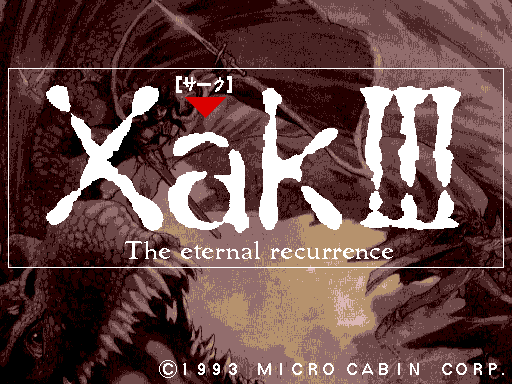
Because the game’s underlying VR and MEAL design still shared so much DNA with Micro Cabin’s MSX era, bringing Latok’s finale home to MSX2, MSX2+, and MSX turbo R felt less like forcing a port onto the wrong hardware and more like reuniting the final chapter with the machines where the series began.
Watch Xak III in motion on MSX
Here is development footage from the MSX port running in English—covering the rainstorm prologue and animated sword-and-dragon title sequence, Fearless Village and the manually redrawn MSX2 menus, Zom Dizae’s assault on Farland Castle, and the 2nd Wave cavalry charge into battle:
Studying the PC-98 original—and fixing genuine 1993 bugs
When recreating a story-heavy RPG on another platform, small details matter—how characters pause during conversations, how the camera pans across a dramatic cutscene, how rooftops and treetops part as you walk behind them, and how each location sets its mood and colors.
Rather than approximate those details by eye, we carefully disassembled and studied the original PC-9801 game so the MSX2 version could follow Micro Cabin’s real game rules and cutscene timing faithfully. Doing that side-by-side comparison also uncovered several genuine 1993 bugs in the original release—allowing us to fix them cleanly across both the MSX2 port and the bonus PC-9801 edition:
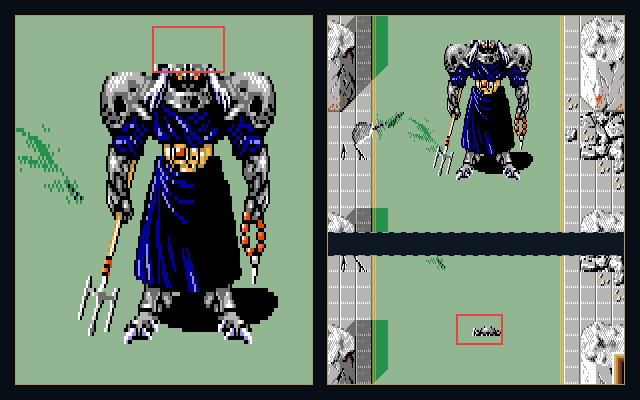
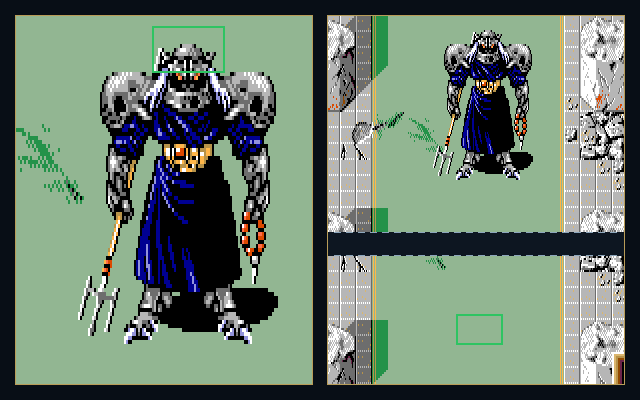
1. Zom Dizae’s detached helmet crown
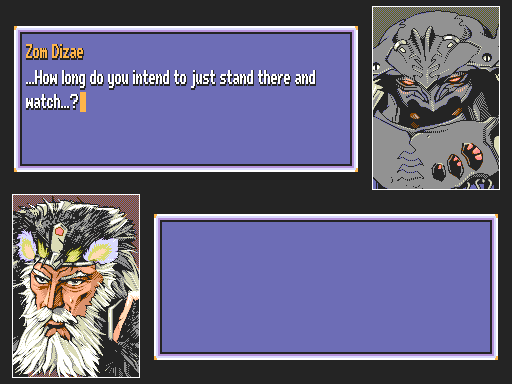
In one of Demon Army commander Zom Dizae’s towering Farland Castle poses, the top crown of his silver helmet sat slightly higher than a single signed byte offset could represent. In the 1993 release, that offset wrapped around vertically—leaving the top of his helmet chopped flat while the missing crown piece appeared floating far below his boots. Re-anchoring the piece restores his full helmet cleanly.
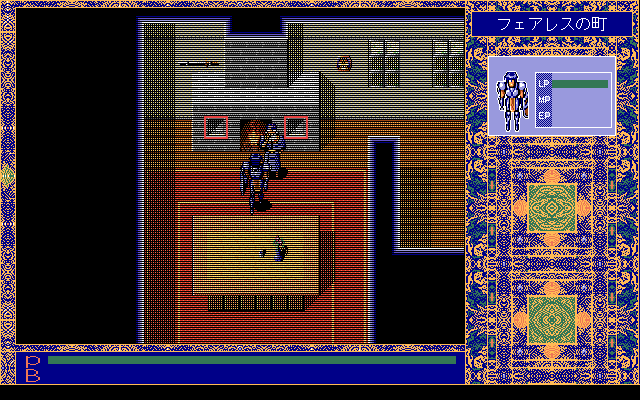
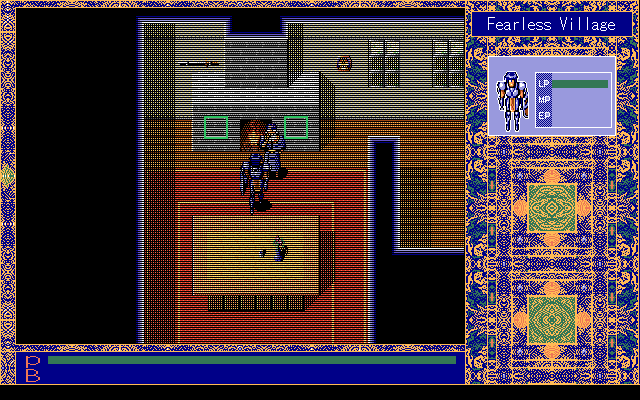
2. Misplaced outdoor doorstep tiles in the Mayor’s stone fireplace
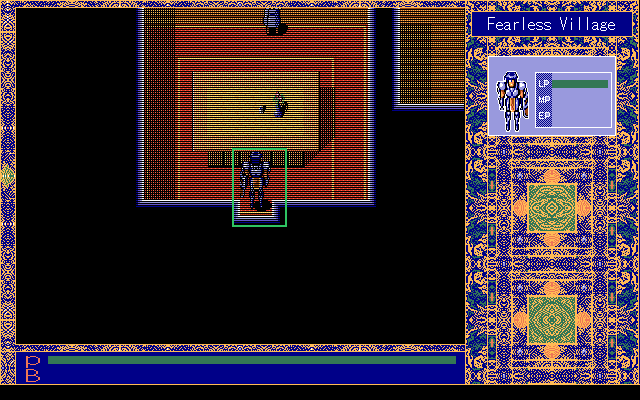
Inside the Mayor’s house in Fearless Village, the original 1993 map accidentally placed two diagonal outdoor doorstep tiles into the bottom-left and bottom-right corners of the stone hearth. Replacing them with proper stone hearth bricks brings the Mayor’s fireplace in line with the rest of the village.
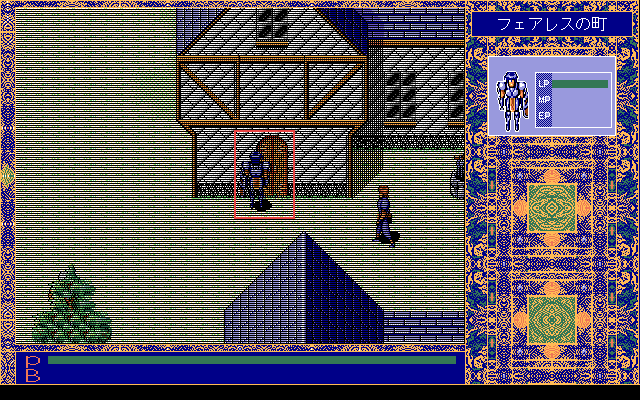
3. Fearless Mayor’s half-broken double door
Outside the Mayor’s mansion in Fearless Village stands a wide two-tile double door—yet in the 1993 release, walking up to the left door panel blocked Latok silently outside, because the trigger check only accounted for one side of Latok’s two-tile width on closed exterior doors. Fixing the door check allows either half of a double door to open naturally.
From an early SCREEN 5 prototype to full SCREEN 7 on MSX2, MSX2+, and Turbo-R
When porting first began, we experimented with running field gameplay in SCREEN 5 (256×212) and switching to SCREEN 7 (512×192) only for portrait conversations. In practice, halving the horizontal resolution cost too much of Micro Cabin’s detailed PC-98 pixel work—it simply did not look good enough, so that early SCREEN 5 build was scrapped completely.
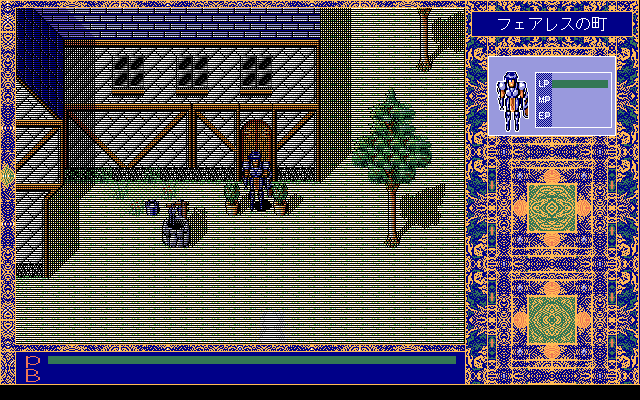
In its place, we chose the more demanding path of carefully porting the entire game into V9938/V9958 SCREEN 7 on a standard 128 KB MSX2 baseline, while automatically taking advantage of the faster processor modes on MSX2+ and MSX turbo R. Every original character animation, stage palette, rainstorm effect, hearth fire, and drifting curl of chimney smoke is kept intact rather than cut down.

For music and sound effects, the game supports Makoto (YM2608 OPNA, selected automatically when present), MSX-MUSIC / FM-PAC (FM + PSG), and pure PSG for unexpanded MSX2 machines—with separate saved volume sliders for FM/PSG, Makoto, and sound effects, alongside cartridge FlashROM saves and instant quick saves.
Manually redrawing the MSX2 interface to make it better than the original
Every border, HUD gauge, party card, status sheet, and camp window was manually and carefully redrawn pixel-by-pixel for the MSX—not simply to fit a 640×400 PC-9801 game into MSX2 SCREEN 7 (512×192), but with the deliberate goal of improving the interface and making it cleaner, clearer, and better than the 1993 original.
On the 1993 PC-9801 screen, a large share of the right sidebar was occupied by static decorative filigree: the character box showed no name or level above its bars, and current Gold was hidden inside the camp menu rather than visible during exploration. On MSX2, we hand-crafted a gold-beveled gameplay frame where every pixel earns its place—adding an always-visible GOLD readout beside the Power (P) and Boss (B) gauges, a centered location plaque at the top right, and enriched party cards displaying each companion’s name, Lv, and live LP / MP / EP bars (with subtle rune-framed empty slots when traveling solo).
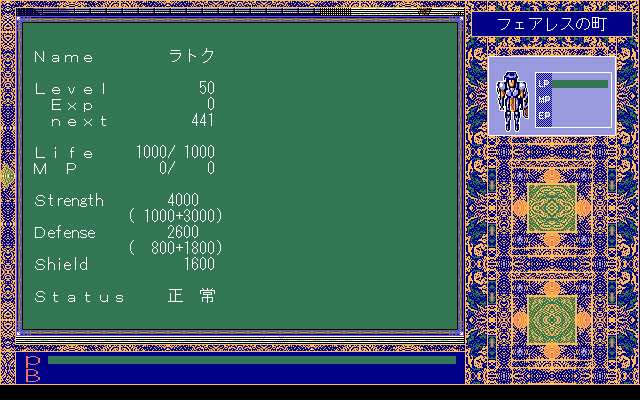
1. A complete two-column Status sheet at a glance
In the 1993 PC-9801 release, the Status window listed only bare stats down the left side with wide full-width English spacing and left the entire right half of the window empty—forcing you to close Status and open Equip just to see what a character was wearing. For MSX2, we redesigned Status into a clean two-column character sheet: Life, MP, EXP, NEXT, column-aligned Strength and Defense breakdowns, and Shield rating sit on the left, while all seven equipment and healing-pouch slots plus Auto Magic appear side-by-side on the right, with instant Left/Right party switching at the top.

2. Full-word Equip slots and dedicated three-box stat breakdowns
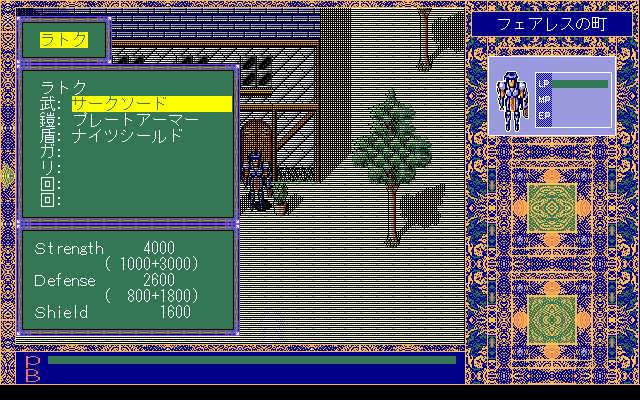
Where the original Equip menu squeezed single-kanji prefixes (“武:”, “鎧:”, “盾:”, “ガ:”, “リ:”, “回:”) onto the left and stacked six lines of parenthetical numbers underneath, the MSX2 Equip screen pairs full English slot names (Weapon through dual healing pouches Heal 1 and Heal 2, switching dynamically to Magic for Fray) and a dedicated right-hand gear browser with three separate bottom stat windows for Strength, Defense, and Shield. Using a two-tier proportional font hierarchy—compact base + bonus equations beside bold total figures—keeps every number legible at a glance, while hardware VDP XOR highlight bars move the cursor instantaneously without redraw lag.

3. Visual Tactics, three-chip audio controls & five window themes
Every remaining camp and boot menu received the same care. Companion AI Tactics combines graphical MEAL stance and recovery gauges with highlighted Off / On and Spread / Focus toggles. Meanwhile, the expanded System screen lets players switch live between Makoto, FM + PSG (MSX-MUSIC), and PSG, adjust three independent remembered volume sliders (FM/PSG Vol, Makoto Vol, and SFX Vol, with one-button mute/unmute), tune Game Speed and Text Speed, and customize all menus and dialogue boxes across five window color themes (Green, Navy, Brown, Black, and Light Blue)—paired with a built-in 34-track Sound Test (Xak Gramophone) on the Boot Menu, 4-slot cartridge FlashROM saves, and F2/F3 instant Quick Save & Quick Load.


Cavalry charges, multi-level castles, and real-time sword combat
Beyond village exploration and story scenes, Xak III throws Latok into fast-moving action sequences and real-time battles—charging on horseback with the Allied Knights toward Farland Castle, clashing with monsters at the castle gates, fighting alongside allied soldiers in the besieged courtyard, and climbing upper rampart bridges to vault over demon barricades.


Jumping, directional sword slashes, Xak Sword energy waves, shield blocking and projectile reflection, multi-elevation stairs and rampart jumps, and autonomous companion AI for party members like Fray and Rune are all running natively on MSX2, MSX2+, and MSX turbo R.


100% accurate English translation and full-detail portraits
Just like our other translation projects, top priority is a 100% accurate, uncut English script that stays true to the Japanese dialogue, character voices, and lore without trimming lines to fit narrow text boxes. Conversations use a clean proportional font with automatic word-wrapping so scenes read naturally.
At the same time, PC-98 Xak III is famous for its tall, expressive character portraits. On MSX2, those portraits are presented at their full original proportions alongside rock-steady, flicker-free dialogue windows so none of Micro Cabin’s artwork is lost.

Bonus: an English & Quality-of-Life edition for NEC PC-9801
Because our translated scripts are maintained in a clean shared format that builds for both platforms, this project also includes a bonus English translation for the original NEC PC-9801 version.
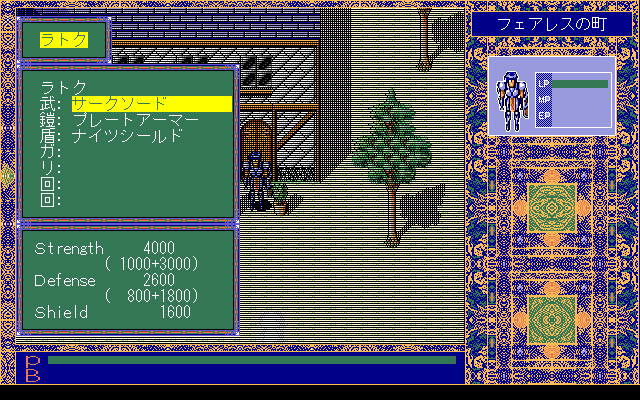
While working on the MSX2 menus, it became clear that several of the original 1993 PC-98 menus used cramped two-letter abbreviations (such as “Wp:”, “Ar:”, “Sh:”, and lowercase “lv”) or awkward mixed-width English labels. We brought our MSX2 Quality-of-Life improvements back to the PC-9801 version as well so both editions feel equally polished:
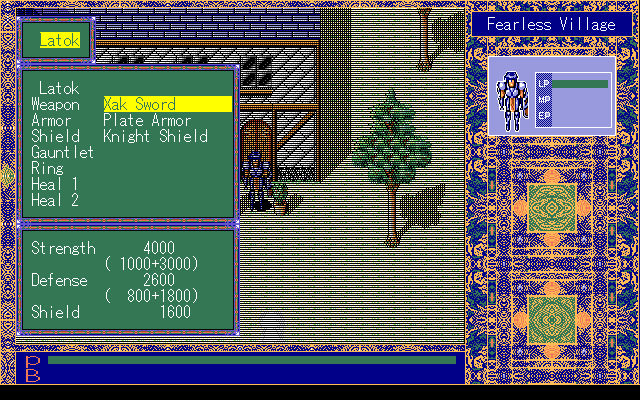
Clearer Menus
Replaces cramped two-letter slot codes and mixed-width labels on PC-98 with clean full-word Status and Equip screens matching MSX2.
Tactics & Save Slots
Upgrades the Tactics layout and Save/Load windows so area names and character levels read cleanly in English.
Shared 1993 Fixes
Brings the sprite, map-tile, and door-trigger fixes discovered during the MSX2 port back to the PC-9801 edition too.
Where the project stands today—and what comes next
Overall progress currently stands at 35%. The core MSX2, MSX2+, and Turbo-R engine, real-time sword combat, jumping, shield defense, companion AI, dual FM soundtrack support, camp and shop interfaces, FlashROM saves, the rainstorm prologue, Fearless Village, the World Map, Zom Dizae’s invasion of Farland Castle, the Allied Garrison, the cavalry assault, and the Farland Castle Courtyard battle are all up and running—alongside the matching bonus PC-9801 English build.
From here, work continues inside Farland Castle’s interior halls, translating and testing the remaining chapters of Latok’s journey, and further optimizing performance on standard MSX2 hardware.