Opening up the cartridge
This is one of my favorite MSX games. I played it a lot in the 80s and 90s, and I always wanted to see what was inside.
It also gave me the name I still use today. Back in 1989, when we started exploring games, the first thing I did was change SHU IWAMOTO in Hinotori’s credits to MAX IWAMOTO. Eventually, the name stayed. Coming back to these credits all these years later makes this project especially personal.
The most interesting part of disassembling Hi no Tori: Houou-hen is finding how much of the game exists outside the part we normally play. There are two original ROM variants with surprisingly small behavioral differences, artwork that never reaches the screen, routines stopped by a single return instruction, and an enemy whose graphics are loaded even though its normal introduction has been disconnected.
My Hinotori project turns the 128 KiB cartridge into a shared, commented Z80 assembly tree. The original Main and A1 targets rebuild byte for byte. That matters: a plausible-looking disassembly is useful, but an exact rebuild gives us a much stronger foundation for investigating the game and checking changes.
There are now four build targets. Main and A1 preserve the original dumps. A2 reproduces the archived one-byte alteration to Main, including its incorrect music loop. Enhanced is the playable enhanced build from the same assembly source, with modern fixes and MSX2+ horizontal scrolling. Its language choice is a runtime option, not another independent source tree. The distinction is important whenever a restored feature appears in a screenshot: that does not mean it was active in the original game.
The release repository, hinotori_msx, keeps the sixteen bank files, shared definitions, target wrappers, and the extra assembly modules needed by Enhanced. Small build and conversion tools support tniasm10, Glass, and SjASMPlus. All four targets produce byte-identical ROMs across the three assemblers: twelve verified builds. Standalone source packages can also be generated for each assembler.
Main versus A1: smaller changes than the byte count suggests
A straight comparison finds 10,640 different bytes at matching ROM offsets. That sounds like a major rewrite. Following the instructions and their references tells a different story: a few inserted or removed instructions move labels, which changes many stored addresses. Ten of the sixteen physical banks are completely identical.
Identifying Main and A1 in GoodMSX
The recovered GoodMSX2 0.999.3 collection contains all three Hinotori archives: the untagged Japanese dump, [a1], and [a2]. Hashing the ROMs inside its Main and A1 archives confirms exact matches to our project originals. The project uses the names Hinotori - Houou Hen (J) for Main and Hinotori - Houou Hen (J) [a1] for A1. The table gives the exact ROM filenames inside the source archives. Both hashes are catalogued under Firebird - Hi no Tori Hououhen in the openMSX software database, with GoodMSX status and the Konami mapper.
| Identifier | Main | A1 |
|---|---|---|
| Source ROM filename | Hinotori - Houou Hen (J).rom | Hinotori - Houou Hen (J) [a1].rom |
| SHA-1 of ROM | D723F2EB1C887DB5448FD56BE5E7C57E60D88E63 | 612C18616BC800D9EB69B9DA3CD29ECA31F50C1C |
| CRC32 of ROM | 3AB5AE57 | D95116B0 |
| ROM size | 131,072 bytes (128 KiB) | 131,072 bytes (128 KiB) |
| openMSX catalog status | GoodMSX; Konami mapper | GoodMSX; Konami mapper |
These checksums identify the uncompressed ROM bytes, not the ZIP archive, an English translation, or Enhanced. Use the hash to match a file even if it has been renamed. (J) is the Japan region tag; [a1] identifies an alternate dump in the naming scheme. It does not, by itself, establish a later release date, an official “revision 1,” or a better dump. The code comparison below describes the differences we can actually verify.
| Area | Main | A1 |
|---|---|---|
| Starting a new game | Can retain the saved-music lock. | Explicitly clears the lock so an old suspended track does not remain marked as saved. |
| Player and stage resets | Skips clearing that lock when the hourglass timer is nonzero. | Clears it unconditionally. |
| Companion cartridge slot detection | Guesses its slot relative to Hinotori’s slot. | Records the slot/subslot actually found by the probe, fixing the assumption on expanded-slot machines. |
| Companion interrupt hook | Replaces the hook without first making its entry harmless. | Writes a return instruction first, then installs the new jump, avoiding entry into a partially written hook. |
| Title copyright line | Starts at X = 72. | Starts at X = 56: sixteen pixels farther left. |
| Redundant instructions | Retains a call to a return-only stub and a jump to the next instruction. | Removes both. |
The maps are not a different campaign. The decoded Main and A1 backgrounds, terrain records, and mobile-enemy placement records match. A1’s meaningful changes are mostly state cleanup and companion-cartridge compatibility, plus the title adjustment. It does not switch on all the unused material described below.
What was left behind
“Unused” covers several different situations. Some routines are explicitly disabled. Some assets have no active reference. Some items retain storage and pickup code but lack the code that would make their apparent purpose work. Those distinctions matter more than simply counting hidden graphics.
The turtle-shell item
Item 07h has a shell-shaped icon, a capacity of three, a pickup handler, and an inventory entry whose display position hides it. It has no standalone spawn in the decoded normal terrain streams or enemy drop tables. The handler writes a value resembling the other temporary-buff timers, but the retail damage and timer paths do not read its slot.
A shield is a reasonable interpretation of the artwork and structure. A working hidden shield is not established by that evidence. Showing the icon and making it collectible does not, by itself, implement protection.
The orb artwork is used by the five Special Kanji
The round orb in the fourteen-icon sheet is used artwork: it forms the base beneath the five Special Kanji, 天・空・水・明・充 (items 24h–28h). The renderer first draws base icon 0Ch, then overlays the appropriate kanji. The separate plain-orb item ID has no normal standalone spawn, but that is a distinction about the item slot, not evidence that the orb picture was discarded.
The code makes the reuse explicit. CP 24h tests the composite item ID; LD leaves those comparison flags intact, so JR NC keeps base 0Ch for the five Special Kanji. The lower composite IDs select base 06h. After the excerpt, the saved item ID selects the kanji overlay.
asm/banks/bank01.asmBLIT_COMPOSITE_STONE_GROUND_ICON:
PUSH HL
PUSH AF
CP 24h
LD A,0Ch
JR NC,.loc_7b87
LD A,06h
.loc_7b87:
CALL OFFSET_AND_BLIT_GROUND_ITEM_ICON
The compass labels behind a return instruction
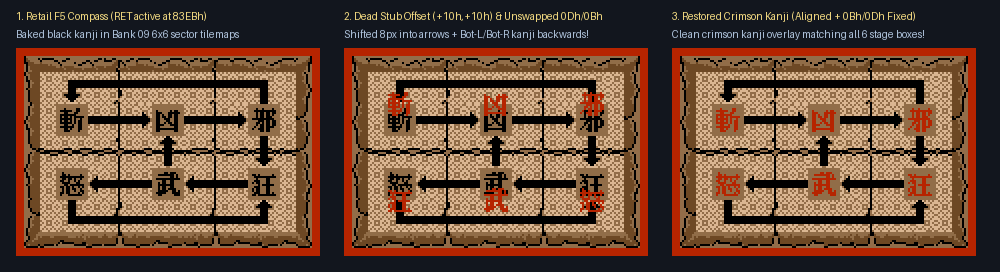
The F5 compass still has a caller that iterates over sector labels, but the drawing routine returns immediately after reading a sector record. Its RET prevents the remaining drawing instructions from executing through this call. Restoring the labels in a research build exposed more unfinished work: record indexing, coordinate/register handling, label placement, and the color path. It was more than a cosmetic switch waiting to be turned on.
In Z80 code, CALL saves a return address and enters a routine; RET returns to that caller. Here the record-reading call still runs. Execution then returns to the sector loop, leaving the coordinate calculation and bitmap copy below it unreachable along this path. The return byte is at address 83ECh in both originals, verified against their ROM bytes.
asm/banks/bank02.asmDRAW_COMPASS_SECTOR_KANJI_STUB:
CALL READ_COMPASS_SECTOR_LAYOUT_RECORD
RET
LD HL,1010h
ADD HL,DE
JP .loc_83f4
.loc_83f4:
CALL BLIT_16X16_WIDE_KANJI_GLYPH_A
LD BC,1010h
LD A,48h
JP LMMM_BLIT_ICON_OR_TILE_RECTRemoving that return alone is insufficient. The reader gives screen coordinates in BC and a tilemap pointer in DE, yet the abandoned body adds 1010h to DE. That is a pointer, not the intended screen position. The ordinary compass remains readable because its black labels are already part of the sector tilemaps.
Other traces of development
The following examples distinguish unreferenced data from routines that are still called but deliberately return early. The excerpts come from the shared assembly with the original Main/A1 paths selected. Labels are names assigned by the disassembly project; they are not recovered Konami source names. Excerpts marked “abridged” omit code for readability.
A possible top-of-screen status layout
UNUSED_PROTO_STATUS_BAR_TEXT contains four positioned strings, all with a Y coordinate of 00h: HI@, SCORE@, P@, and STAGE@. Each record begins with X and Y, followed by text; FEh starts another positioned record and FFh ends the stream.
asm/banks/bank00.asmUNUSED_PROTO_STATUS_BAR_TEXT:
DB 70h,00h,"HI@",FEh
DB 08h,00h,"SCORE@",FEh
DB D4h,00h,"P@",FEh
DB 6Ch,00h,"STAGE@",FFhThe shared Y position suggests a top-row status display, but the labels alone do not prove that a complete earlier HUD ever ran. No reference to this table is identified in the maintained disassembly. The shipped pause path instead explicitly loads PAUSE_OVERLAY_TEXT and calls DRAW_SCROLLED_POSITIONED_TEXT to show its stage, lives, and score information.
A second, unused “STAGE” label
A separate positioned string, STAGE_INTRO_TITLE_TEXT, sits nearby without an identified reference. Its first two bytes are written as printable characters in the assembly: the backtick encodes X = 60h, and 8 encodes Y = 38h. They are positioning bytes, not part of the word shown to the player.
asm/banks/bank00.asmSTAGE_INTRO_TITLE_TEXT:
DB "`8STAGE",00h,00h,00h,FFhThis preserves another proposed text placement. It does not establish when it was used, why it was abandoned, or a missing stage-introduction feature that can be restored by displaying this string alone.
Screen shake with no identified caller
UNUSED_UPDATE_VDP_SCREEN_SHAKE first requires gameplay state 05h, a nonzero shake flag, and an even FRAME_COUNTER. It eventually writes the display-adjust register, 12h (register 18), through the BIOS. This shifts the displayed picture; it does not rewrite the terrain map.
asm/banks/bank00.asmUNUSED_UPDATE_VDP_SCREEN_SHAKE:
LD A,(MAIN_STATE)
CP 05h
RET NZ
LD HL,UNUSED_SCREEN_SHAKE_FLAG
LD A,(HL)
OR A
RET Z
LD A,(FRAME_COUNTER)
AND 01h
RET NZ
; ... table selection and index update omitted ...
.loc_49b9:
LD C,12h
JP BIOS_WRTVDPThe full routine uses the six values E0h, 00h, 10h, 01h, 20h, 0Fh; the leading 06h in its table is the length. Bit 0 of the flag requests a step and is consumed by the routine. On a later eligible call without another request, the code clears the flag and writes zero to restore the display adjustment. There is no identified caller or active request producer, so the surviving routine is not evidence of a working hidden shake effect in retail play.
A tile-collision override system disabled in several places
A dormant per-stage patcher writes tile-collision attributes into C900h–C9FFh. It selects a list by LEVEL_INDEX, reads pairs of attribute, tile ID, and stops at FFh. Setting B to C9h makes LD (BC),A write the selected attribute at address C900h + tile ID.
asm/banks/bank01.asmNOOP_STAGE_ATTR_OVERRIDE_STUB:
RET
UNUSED_PATCH_STAGE_TILE_ATTRS:
LD A,(LEVEL_INDEX)
LD DE,UNUSED_STAGE_ATTR_PTR_TABLE
CALL READ_WORD_FROM_DE_TABLE_A
EX DE,HL
.loc_67a8:
LD A,(HL)
CP FFh
RET Z
INC HL
LD C,(HL)
INC HL
LD B,C9h
LD (BC),AThere are three independent signs of retirement: the leading RET blocks the body; all eight entries in UNUSED_STAGE_ATTR_PTR_TABLE point to the same empty FFh list; and A1 removes one redundant call that Main retains. Another stage-loading call still reaches the harmless stub. Two older lists survive after the terminator, but the pointer table selects neither.
The active graphics-descriptor loader already fills the collision table while loading stage tiles. Simply removing the return would still select an empty list, and reconnecting an old list could change terrain collision. This is a discarded implementation path, not a ready-made bonus gameplay feature.
The graphics shown below
The unused 輪廻 kanji strip and four prototype enemy designs are covered in the next gallery. Look below for the kanji image and more details, including how it differs from the working recovery graphic, followed by the enemy poses. Other unused sprite streams contain drafts of familiar bosses; their presence does not establish additional finished bosses.
These findings show what survives in the cartridge. Their original purpose and the reasons for removing them remain interpretations unless supported by a live call path or other evidence.
Unused graphics, out of the ROM
Here are the actual exported pixels behind those findings. The small graphics are enlarged with hard pixel edges. No new artwork has been drawn for this gallery.
The extra kanji: 輪廻

1C14Bh–1C1AAh, including two blank tiles. White-on-black shows the original one-bit mask; no active in-game color assignment is established for this unused strip. Download the original-size export PNG.
This is the extra kanji relevant to the Game Over/rebirth discussion. It fits the theme, but the verified finding is narrower: these tiles sit immediately after the shared kanji bank and are left out of its normal upload. I have not identified a retail Game Over call that displays them.
The shipped Game Over heading is the literal text GAME OVER. The Japanese recovery display uses the already-loaded 復活 graphic; Enhanced’s English mode renders “REBIRTH” there. The unused 輪廻 strip should therefore be distinguished from that working recovery graphic. Its intended screen remains an open question.
Four unused enemy designs
These poses come from the project’s Unused ROM Sprites export. The names describe their appearance, rather than confirmed original character names. Their shapes are decoded from the ROM; the exporter combines sprite layers using chosen color pairs and the player palette for inspection. Transparent color index zero is shown over black. Treat the colors and suggested pose order as reconstruction choices, not proof of a finished enemy’s appearance or behavior.
 Tall pose
 Wide pose
Floating skull / jellyfish
Two pulse-like poses from raw data at addresses 71C5h and 7205h (Bank 07).
 Standing pose
Horned demon warrior
One tall pose from the compressed stream at address 7245h (Bank 07).
 Ripple pose
 Raised-claw pose
 Full-body pose
Emerging swamp creature
Three poses reconstructed from addresses 7DF2h, 7D4Dh and 7E77h (Bank 07).
 Stride A
 Stride B
Tunic-wearing warrior
Two stride-like poses from physical ROM offsets 101E3h and 1024Eh (Bank 08).
Unused graphics do not automatically mean unused, fully functioning enemies. Unlike Enemy 16h, these four exports do not establish a complete surviving spawn-and-behavior path. The cartridge also contains draft graphics for several familiar bosses; those are alternate artwork, not necessarily additional bosses.
The mystery of Enemy 16h
First, the number: 16h is hexadecimal, or decimal 22. It is the object-type ID used in the disassembly, not a claim that this is the sixteenth enemy encountered during play.
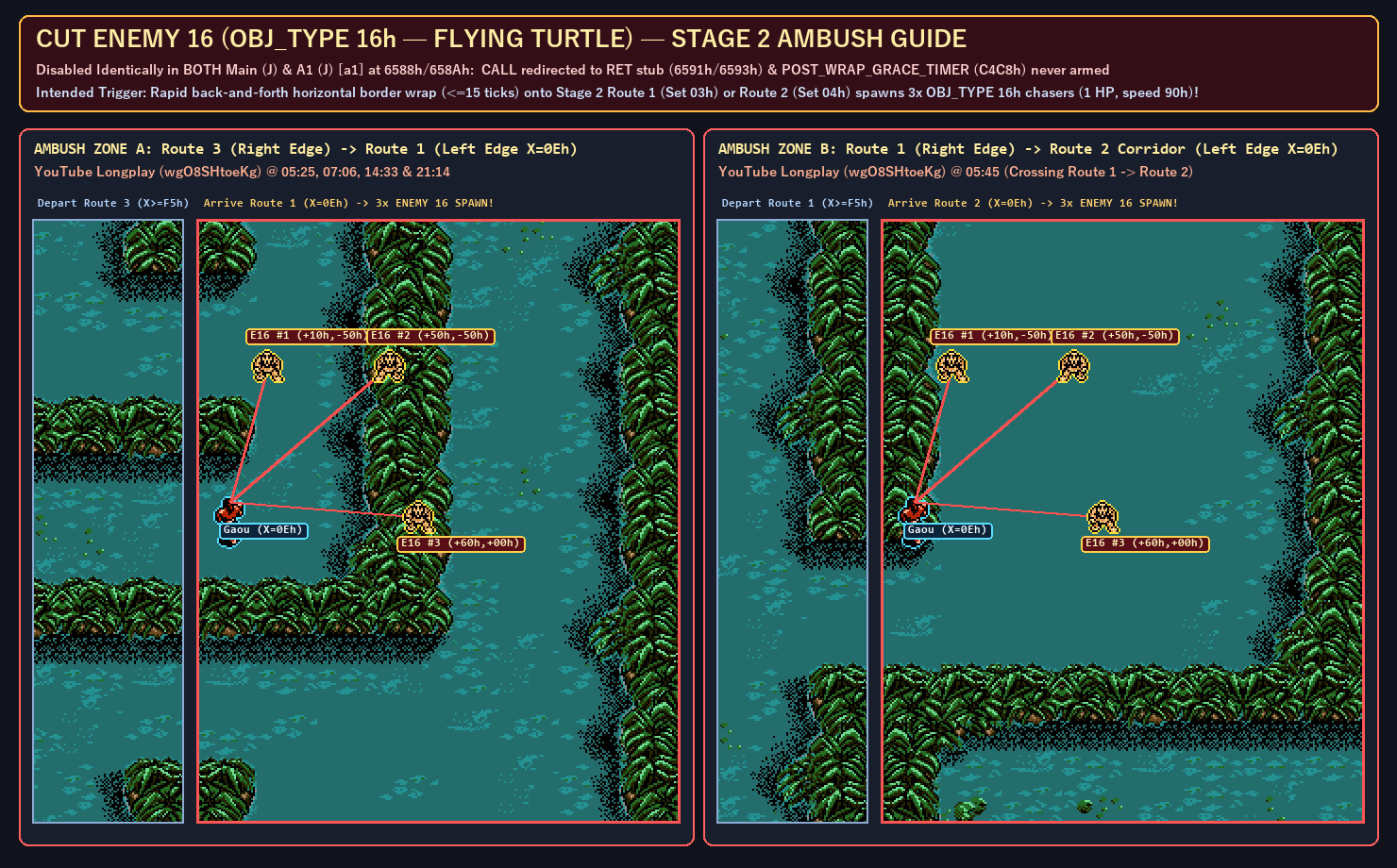
This one is more substantial than an unused picture. Its movement and spawning logic survive, and its sprite resource is loaded on the first two routes of Level 2. Yet the normal retail route-crossing hook calls a do-nothing return stub instead of reaching the surviving ambush logic.
The disconnected route-crossing hook
Enemy 16h is a different kind of disabled path. The retail route hook calls a one-instruction stub and clears the route-change flag. It never calls the surviving timer check. This excerpt shows the original branch; Enhanced selects a separate branch in the same source.
asm/banks/bank01.asmRUN_POST_HORIZ_WRAP_HOOK_AND_CLEAR:
CALL NOOP_POST_TRANSITION_HOOK
LD HL,HORIZ_WRAP_PENDING_FLAG
LD (HL),00h
RET
NOOP_POST_TRANSITION_HOOK:
RETThe surviving condition is unusually specific. One horizontal route crossing arms a counter. A quick crossing back, while the counter is between 01h and 0Fh, can summon up to three homing enemies around Gao if the destination has their patterns loaded. At a 30 Hz gameplay update rate, that is roughly half a second.
That makes an anti-backtracking ambush a plausible reading of the code: quickly reversing over a boundary provokes an attack. It is an interpretation of the trigger, not a documented statement from the original designers. The reason it was disconnected remains unknown.
In Enhanced, active horizontal scrolling attempts that formation on each eligible entry into Level 2 Route 1 or Route 2. Route 3 does not load the turtle graphics. With H. SCROLL off, the restored rapid-return condition remains. The enemy is not spawned continuously while standing still, and the usual object-allocation limits still apply.
Possibly, I am the first player to have killed this restored enemy. I cannot know for sure, but it feels very special :)
One misleading clue during testing was a tan enemy that looked like Gao. A separate route-transition bug could leave an outgoing enemy queued after its graphics were unloaded. Its missing pattern base then pointed at Gao’s artwork. Clearing those stale requests fixed that reproduction; a Gao-shaped enemy is not evidence of a second secret character, and the particular screenshot alone was not enough to identify its object type.
All six levels, unfolded
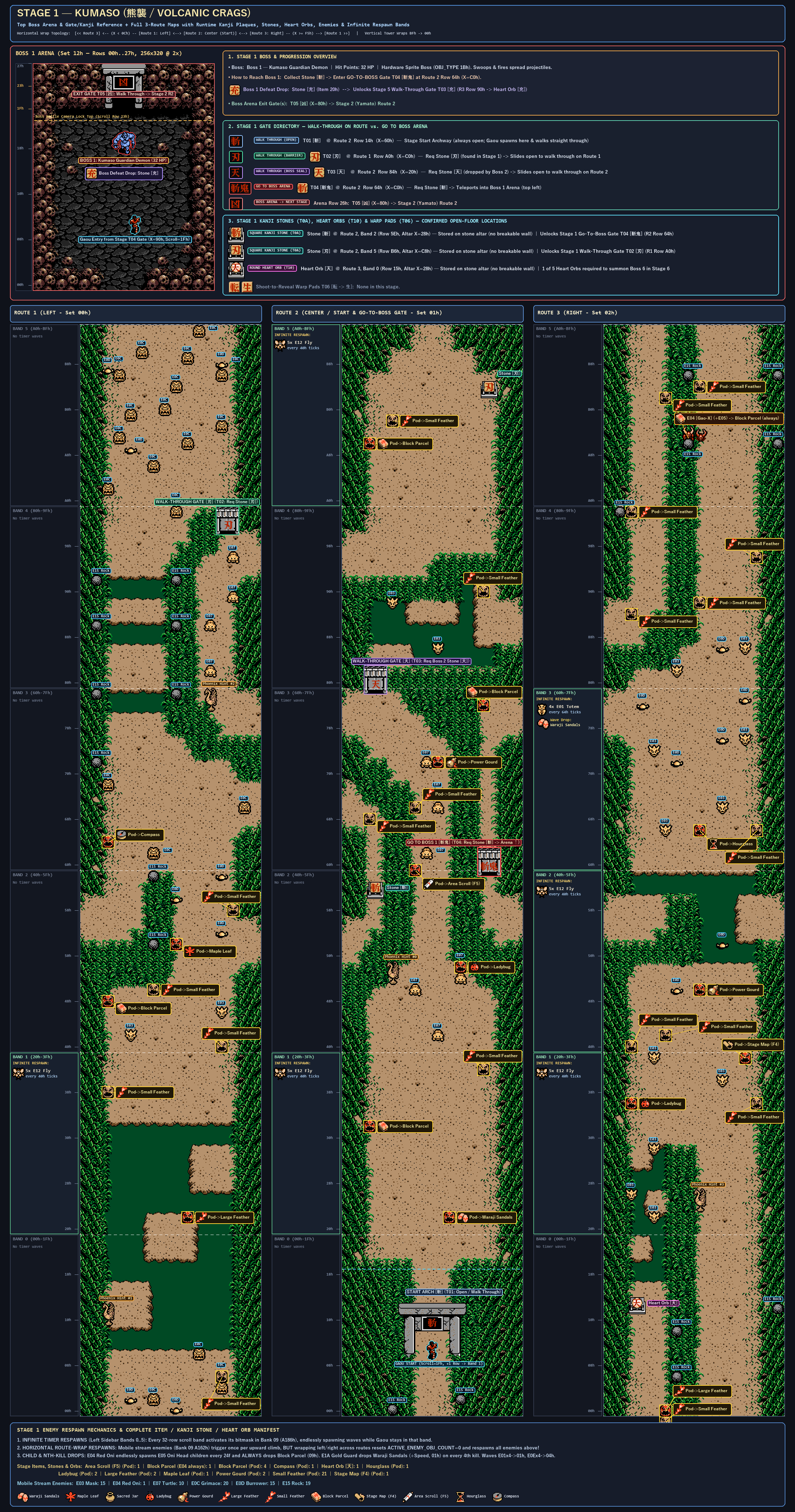
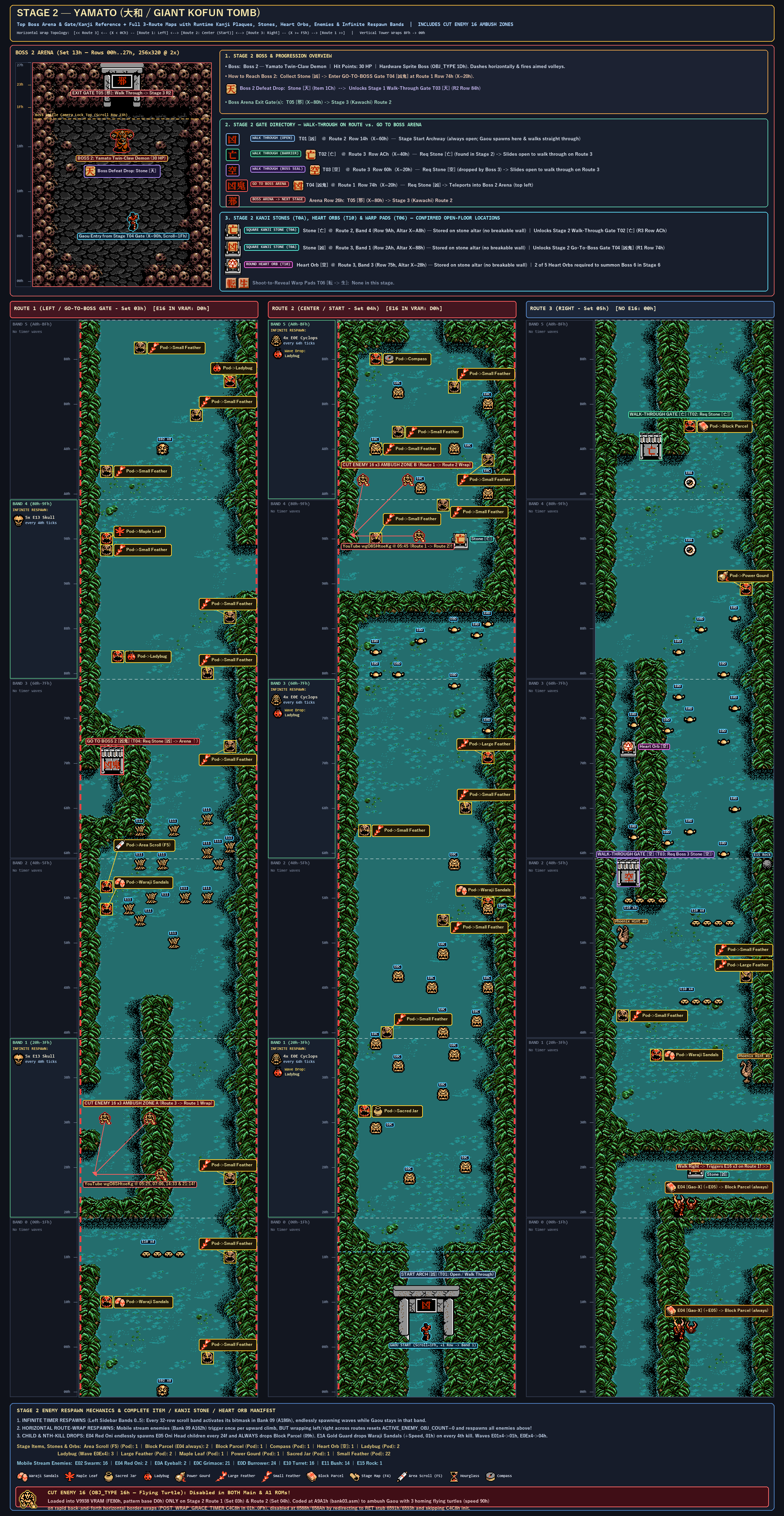
Each normal level has three parallel vertical routes. A route’s background is 256 pixels wide and 1,536 pixels tall; moving across its horizontal boundary takes Gao into a neighboring route. Seeing all three together makes gates, repeated scenery, item placement, and route changes much easier to follow.
These annotated maps were decoded from A1. Each image includes the three routes, a separate boss-arena panel, a gate and kanji reference, and object annotations. Main uses the same decoded background and placement data. Names below follow the map captions. The full-size maps are available here in the article; the minimal source repository contains the files needed to build the game.
Kumaso
Volcanic crags
Yamato
Giant kofun tomb
Kawachi
Ancient ruins
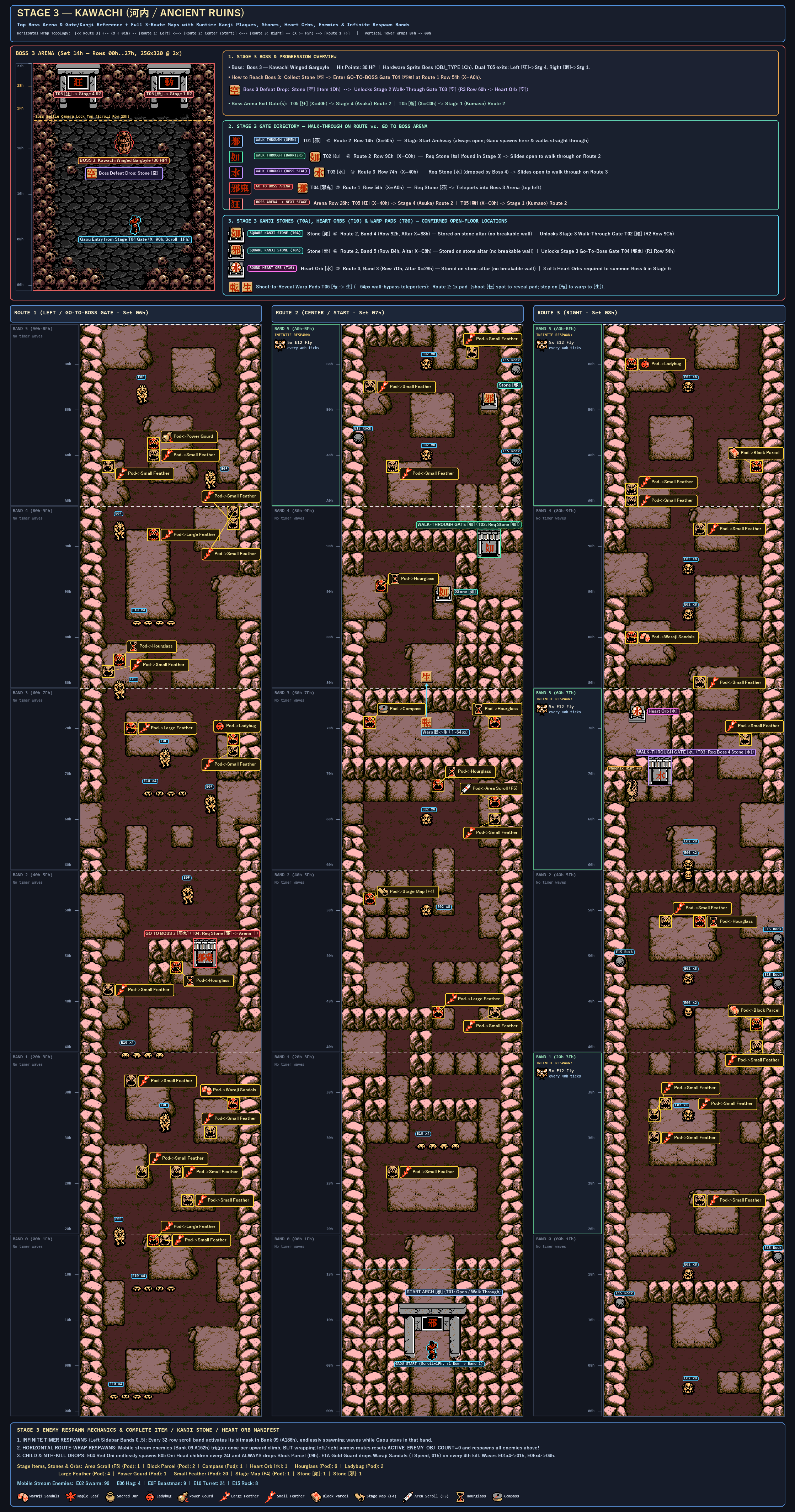
Asuka
Stone temple
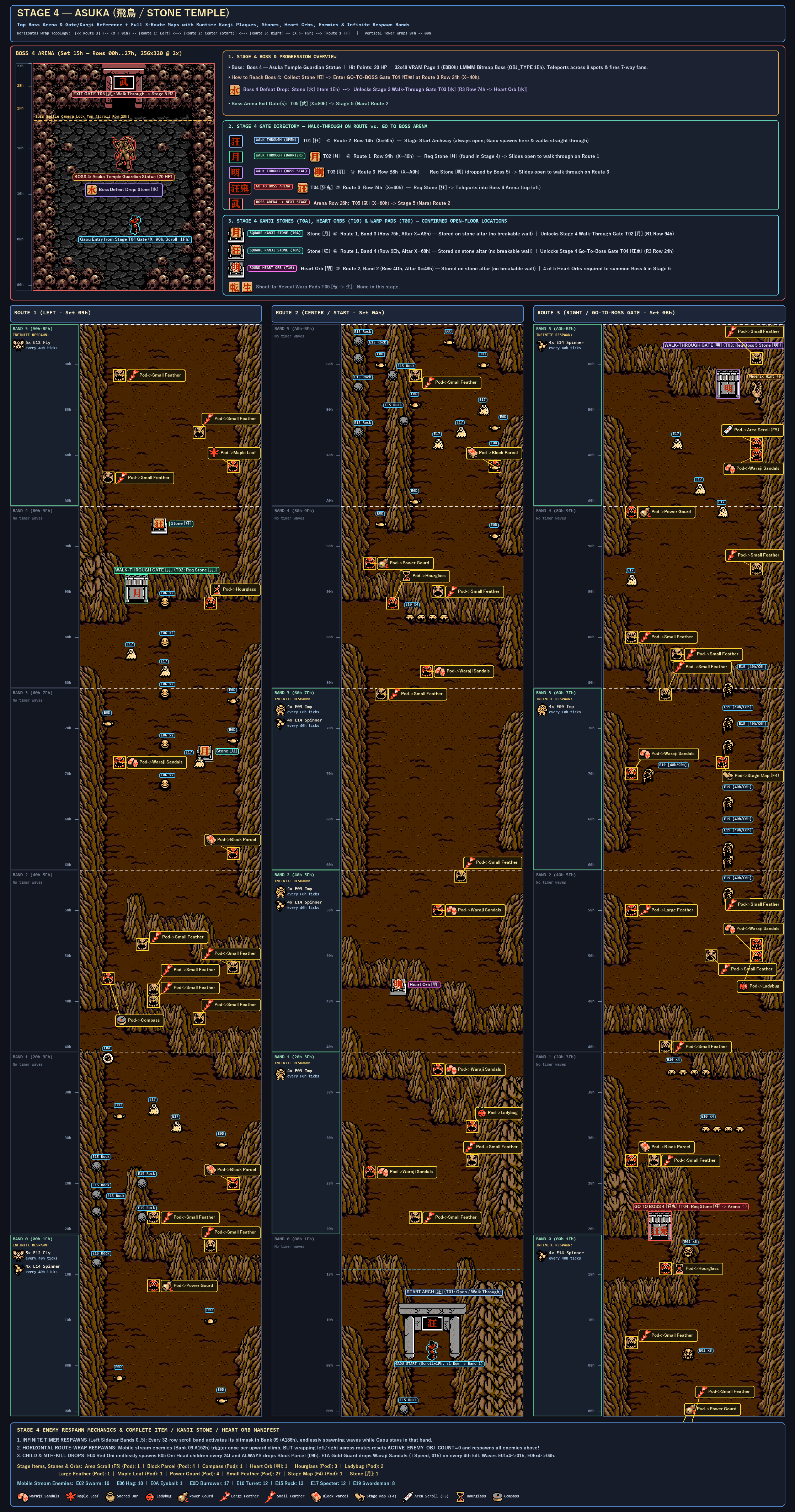
Nara
Todai-ji construction
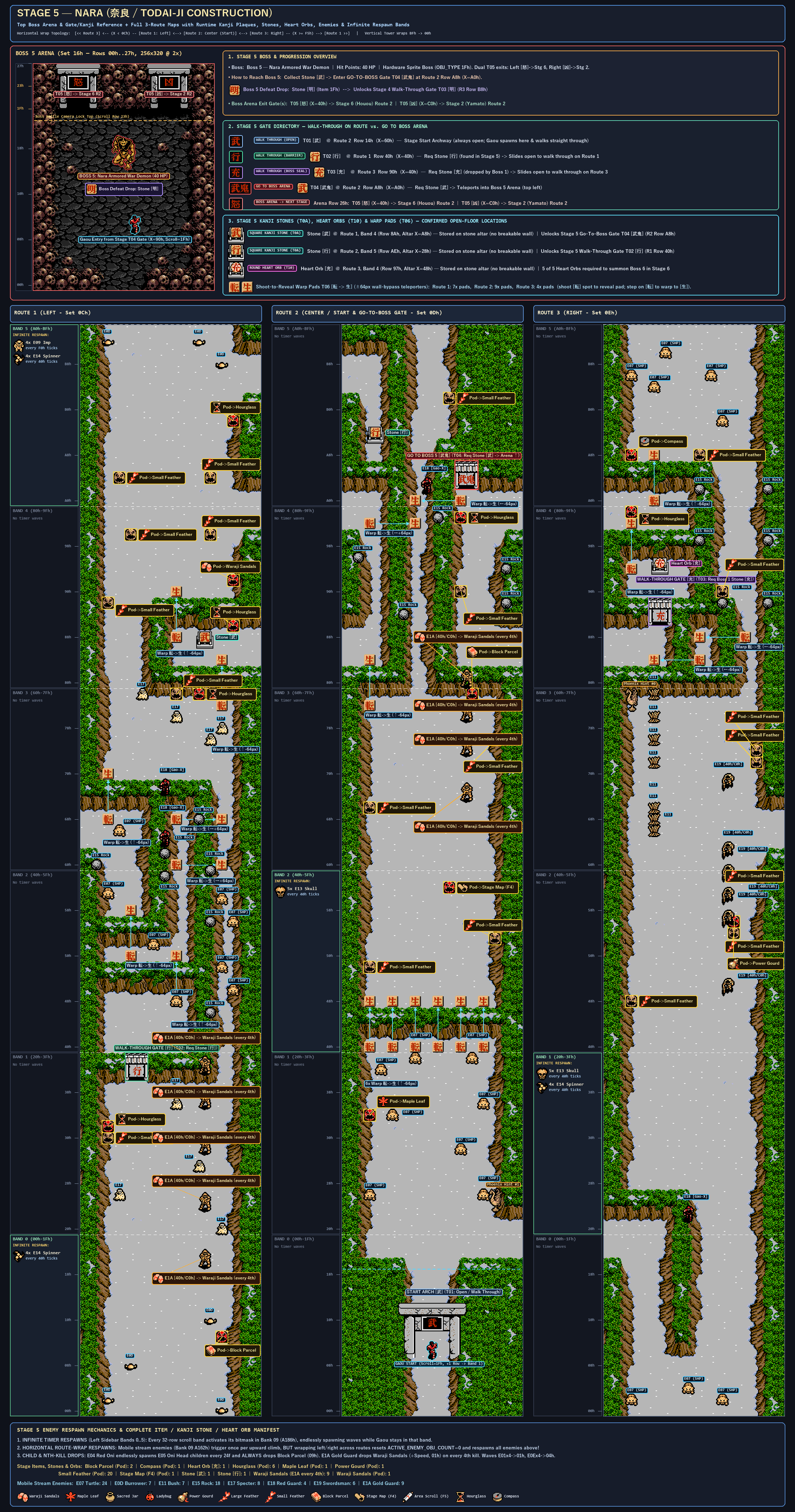
Houou Sanctum
Final shrine
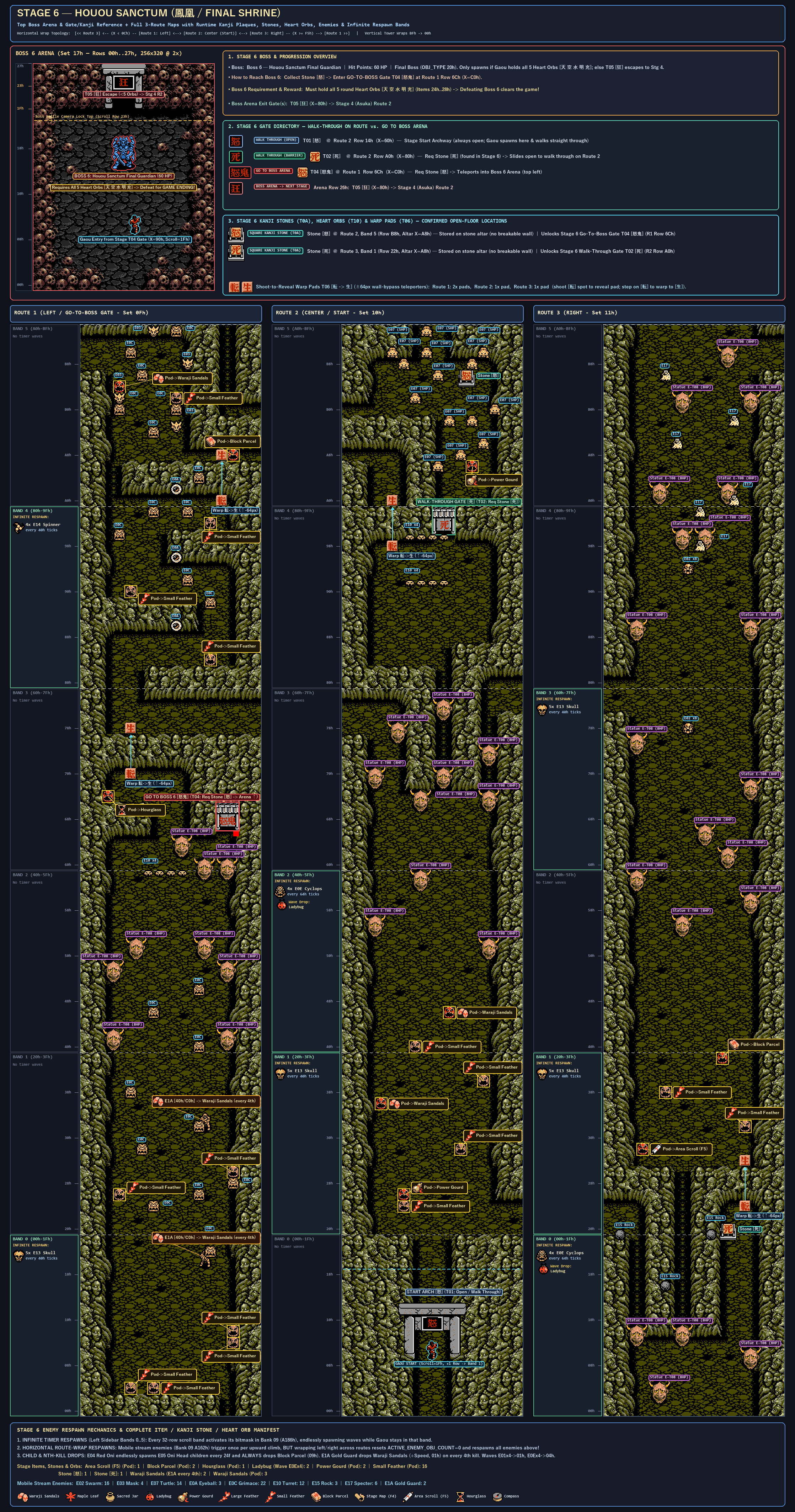
The backgrounds were reconstructed from the ROM’s tile dictionaries and strip streams, then checked against emulator captures. The annotation layer adds decoded object and gate information. A static map can explain where a trigger is defined; it cannot reproduce every live enemy trajectory, destroyed object, or change in the scrolling tile buffer.
The ending, a hidden message, and a familiar name
There is an extra password message in the original ending, but it is hidden rather than unused. Press HOME while the final Firebird speech is still displayed, during the pause before the credits logo appears. The game checks that key, displays the bonus message once, and restarts the pause timer.
The Japanese message reveals FULLITEMDAYOON. The English message reads THESEAREALLTHEITEMS.
The credit that became my name
Here is the original SHU IWAMOTO credit that I changed back in 1989. Seeing the same text in the disassembly brings me right back to that first edit.
asm/banks/bank06.asmENDING_CREDITS_LINE_AB91:
DB 10h,"DESIGNER",A9h,A9h,A9h,A9h,"SHU",A9h,"IWAMOTO",FFhPlay Hinotori Enhanced
Enhanced is released, and compiling is optional. Use the automatic ROM patcher below, or choose one IPS patch for the original Japanese ROM you have:
- Main → Enhanced — for the original
(J)dump. - A1 → Enhanced — for
(J) [a1]. - A2 → Enhanced — for
(J) [a2].
Apply exactly one patch to an uncompressed original ROM with an IPS patcher. Match its SHA-1 against the original-ROM table above; these patches are not for an already translated or modified ROM. Each produces the same Enhanced ROM. Keep the original file and save the result as hinotori-enhanced [Konami].rom: the filename hint makes WebMSX select the correct mapper. You can also choose Cartridge 1 → Set ROM Format → Konami manually.
Use an MSX2 or later with 128 KB of VRAM, or MSX2+ for hardware horizontal scrolling. Enhanced selects 60 Hz at startup on PAL machines too, to keep the intended music and gameplay speed. Fully reset the emulator after loading a new build; an old save state restores its old RAM code and settings.
Enhanced also makes fuller use of the machine’s 128 KB of VRAM for faster screen changes. It keeps map, compass, bird-message, and common graphics ready in video memory, caches the current stage’s tiles, and gives popup windows their own background-backup area. The VDP can reuse or copy these graphics instead of the CPU repeatedly unpacking and reloading them. This reduces the wait when opening information screens and returning to gameplay, including on a standard-speed MSX2. These graphics optimizations work in both language modes, alongside the automatic turbo support on compatible machines.
Both Japanese and English fit in a single 128 KB (131,072-byte) Enhanced ROM, the same cartridge size as the originals. Recompressing game data with CBS Cruncher helped make room for the two languages and the enhancements. This project used CBS Cruncher v5.5; the language is selected at runtime.
The original targets stay unchanged so there is always a reliable reference. Enhanced builds on A1 and adds Japanese/English selection, continuous MSX2+ hardware horizontal scrolling, border masking, and automatic turbo support. It also incorporates BiFi’s Level 4 boss-tablet palette fix and Game Master title-screen restoration fix in both language modes. The MSX Translations English translation by 232 and BiFi credits 232 for translation and icon design, and BiFi for coding, graphics, and manual layout; the two fixes come from BiFi’s FBIRDFIX.IPS.
Testing has already exposed how closely the old assumptions fit the original camera. Route changes affect enemy graphics, delayed spawns, terrain objects, and saved backgrounds. The restored Enemy 16h now has a trigger appropriate to continuous scrolling, and stale outgoing enemy requests are cleared before they can use the wrong graphics.
Even a password exposed a separate timing bug: its success sound could end before a pending fade-out, letting that fade stop the newly started stage music. Enhanced now waits for both to finish before leaving the password screen. Normal passwords use the original shared key in either language mode.
Enhanced is still being play-tested. It is not a claim that every abandoned feature has been completed or that the original game had hardware horizontal scrolling. The old restoration showcase ROMs were research tools; Main, A1, A2, and Enhanced share the maintained assembly; A2 is included for archival reproduction.
Following the evidence
The source release is maintained in hinotori_msx. It contains the sixteen commented bank files and the definitions, Enhanced modules, and tools needed to build Main, A1, A2, and Enhanced with tniasm10, Glass, or SjASMPlus. The maps, graphics galleries, and music comparisons are presented in this article. Code excerpts were checked against asm/banks/bank00.asm (text records and screen shake), bank01.asm (orb drawing, collision overrides, and route hook), and bank02.asm (compass overlay), which are included in the release repository. They show original-path instructions, not suggested patches.
Research snapshot: November 9, 2026. Updated November 10 with the ending’s HOME-key message, the story behind my name, Enhanced IPS downloads, and an automatic browser patcher. Artwork and game design belong to Konami and their respective rights holders; the maps and captures are presented here to explain the disassembly findings.
Make your ROM Enhanced
Drop in your original Hinotori ROM. The patcher detects Main, A1, or A2 and chooses the right patch for you.
Choose your ROM
One original, uncompressed .rom file. Everything happens in your browser; your ROM is never uploaded.
One cartridge. Both languages.
Japanese and English, smooth MSX2+ horizontal scrolling, restored Enemy 16h, and the latest fixes — all in 128 KB.
The download is named hinotori-enhanced [Konami].rom for WebMSX. Use MSX2 or later with 128 KB of VRAM; MSX2+ or turbo R enables hardware scrolling. Start with a full emulator reset.