A game I played endlessly on PC in the 1980s
Back in the 1980s, when I was a kid, Digger was one of those PC games I played over and over again. Anyone who spent hours in front of an early IBM PC compatible remembers it the instant it starts: the unmistakable CGA mine walls, the cheerful Popcorn melody chirping non-stop out of the internal speaker, the nervous wobble of a heavy gold bag before it drops down a shaft, and the panic when a wide-eyed Nobbin loses patience, turns into a fierce Hobbin, and starts chewing straight through the earth after your Digger Mobile.
Even decades later, few arcade games feel as crisp and immediate as Windmill Software’s 1983 classic. Every turn, every risky emerald streak, and every split-second shot down a narrow tunnel is built around tight timing and muscle memory—which made bringing Digger to MSX something I had wanted to do for a long time.
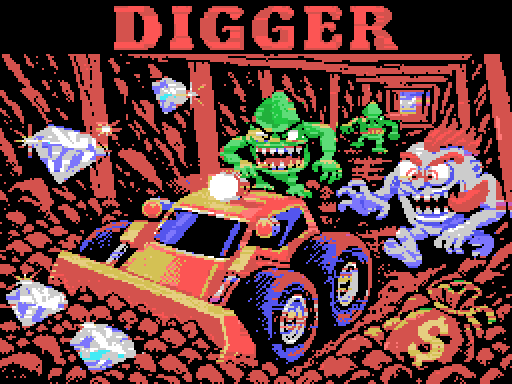
SCREEN 2): Russ Liota’s classic 1983 booklet cover adapted into 256×192 tile-and-color patterns for standard MSX1 hardware.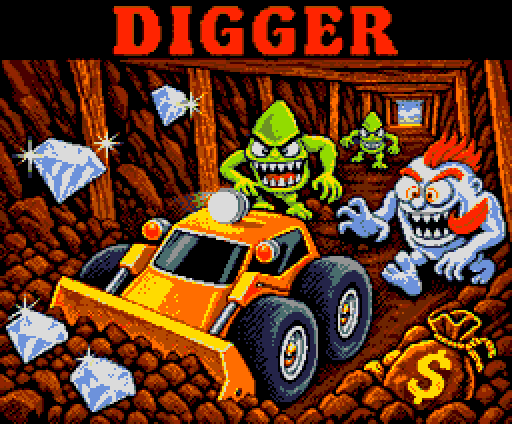
SCREEN 5): Dedicated 256×212 custom-palette bitmap version shown when booting the cartridge in MSX2 mode.From an MSX2 project to an MSX1 challenge
Originally, I decided to build an MSX2 version of Digger for the MSXdev competition. On paper, MSX2 was the natural home for it: V9938 SCREEN 5 bitmap graphics, a custom 16-color palette matched to the original CGA shades, and multi-color OR-blended hardware sprites made it possible to recreate the PC visuals without color clash.
Then came the twist: this year, MSXdev moved its competition category to classic MSX1.
Instead of setting Digger aside for another year, I decided to take it as a personal challenge and build a true MSX1 version as well—written in pure Z80 assembly and engineered to run even on an unexpanded 16 KB RAM / 16 KB VRAM MSX1 machine. Fitting a game that originally demanded a 64 KB IBM PC into 16 KB of MSX1 RAM meant counting every byte of working memory, pre-shifting title tiles, streaming dirty 8×8 character updates within strict VBlank budgets, and sharing hardware sprite slots cleanly without losing a single gameplay rule.
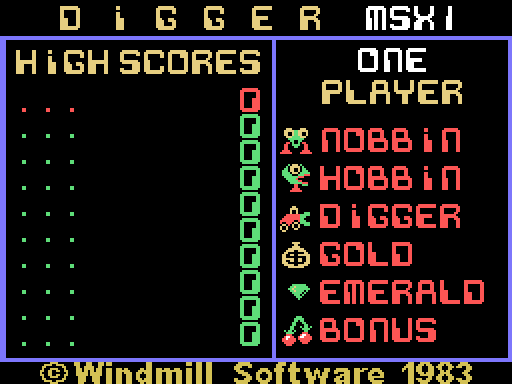
DIGGER letters, and VBlank pixel-dissolve footer.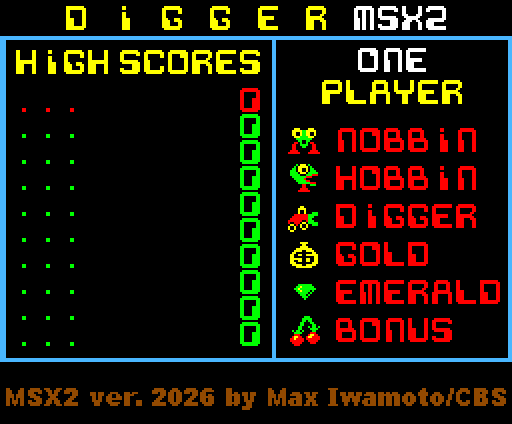
212 lines): Hidden-page VDP reveals, hardware-sprite logo wave, and three-color palette-blended footer alternating between Windmill Software 1983 and Code Busters 2026.Making it look, play, and feel exactly like the 1983 original
From the very start, the main idea was simple and non-negotiable: the game had to look and play/feel just like the PC original. Anyone who grew up playing Digger can tell within ten seconds if a port merely borrows the sprites while changing the movement physics, bag timing, or cornering.
Rather than eyeball the mechanics, both MSX versions run on one shared gameplay core built around the exact rules and timing of the 1983 game:
Exact Grid Cornering
Releasing the keys stops Digger immediately, reversing along a shaft happens on the spot, and perpendicular turns wait cleanly for the next tunnel junction—backed by a two-tap direction buffer so quick corner inputs are never dropped.
Original 14.915 Hz Tempo
A fractional VBlank clock accumulator keeps gameplay locked to the original PC PIT cadence (1,193,181 Hz / 80,000) whether your MSX runs at 60 Hz NTSC or 50 Hz PAL.
All 8 Mines & Rules
Every original map, soil pattern, chain-pushed gold bag, one-row intact drop vs. multi-row bag break, eight-emerald +250 octave streak, Nobbin-to-Hobbin transformation, and RIP gravestone sequence is preserved.
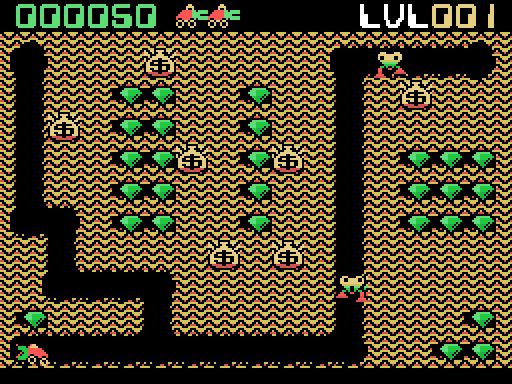
SCREEN 2, 16 KB RAM): Three-layer hardware-sprite Digger Mobile, double-buffered dirty-tile uploads, and opportunistic half-step enemy motion.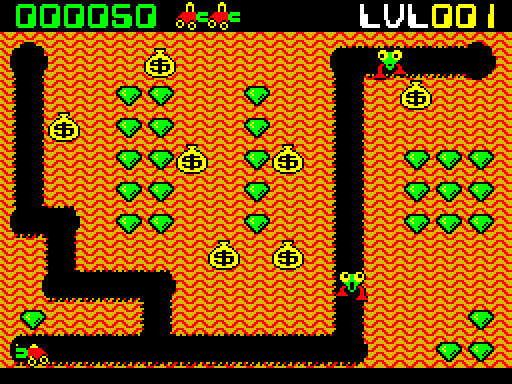
SCREEN 5, Hold F2 at boot): The exact same Level 1 moment rendered with CGA-matched custom palette colors and mode-2 multi-color sprites.Even the Bonus Round transition received special care. When every monster in a wave has entered the mine, cherries appear in the upper-right corner; grabbing them turns the tables so you can chase down Nobbins and Hobbins for 200, 400, 800, and 1,600 points. During the 1.3-second entry and expiry warnings, the outer border flashes and the mine soil shifts brightness—while carved tunnels stay pure black so the playfield never suffers from harsh full-screen flicker.


Popcorn, William Tell, and PC speaker magic on the PSG
Half of Digger’s personality lives in its sound. On an 80s PC, a single 1-bit speaker somehow juggled Popcorn during normal play, Rossini’s William Tell Overture during Bonus Mode, and Chopin’s Funeral March over the RIP headstone—all while rising emerald octaves, wobbling bags, fireballs, and eating cues interrupted the tune.
When adapting that soundtrack to the MSX’s three-channel AY-3-8910 PSG, simply playing continuous background music on Channel A while firing sound effects on Channels B and C did not sound right at all. Looking closely at Windmill’s original 1983 DOS timer routine showed why: whenever a sound effect produced an audible pulse, it momentarily took over the speaker while the melody clock kept advancing silently underneath, letting Popcorn duck out for a fraction of a second and pop right back in between pulses.
Reproducing that exact effect-gated melody ducking on the PSG—using compact offline-deduplicated register streams that need only 37–48 bytes of RAM—instantly brought back the unmistakable rhythm of the PC original. On MSX1, all prepared PSG registers are flushed right at the start of every VBlank before variable tile uploads begin, keeping musical timing rock-steady even when five Hobbins are chewing through the mine at once.
Keeping both worlds: one dual-game cartridge
Once the MSX1 game was finished, tested on real 16 KB hardware, and ready for MSXdev26, I looked back at the MSX2 version where everything had started—and decided there was no reason to leave it behind. Instead of releasing two separate games, I packed both complete versions into a single dual-game ROM.
By default, the cartridge boots straight into the MSX1 version on any MSX, MSX2, MSX2+, or MSX turbo R computer. If you hold F2 during startup or reset on an MSX2 or newer machine, the boot selector launches the dedicated MSX2 presentation instead—unlocking VBlank-interpolated enemy, falling-bag, and fireball motion, zero-wait clear-path player steps, smooth palette fades, automatic MSX2+ / Turbo-R turbo engagement, and live Ctrl + Cursor Keys screen centering (a direct nod to the Ctrl + arrow keys picture shift in the 1983 IBM PC manual!).
| Feature | MSX1 Mode (Default Boot) | MSX2 Mode (Hold F2 at Boot) |
|---|---|---|
| Minimum hardware | Any MSX with 16 KB RAM & 16 KB VRAM |
MSX2 / MSX2+ / Turbo-R with 64 KB RAM & 128 KB VRAM |
| Video & sprites | TMS9918A SCREEN 2 tiles + 3-layer hardware sprites |
V9938 SCREEN 5 custom CGA palette + mode-2 OR sprites |
| Motion & transitions | VBlank player & shot micro-steps + opportunistic enemy midpoints | Full VBlank actor interpolation, clear-path zero-wait steps & palette fades |
| Display & speed extras | Runs identically across 50 Hz PAL and 60 Hz NTSC |
Live Ctrl + arrows CRT screen centering & automatic MSX2+ / R800 turbo |
| Saved high scores | Dedicated MSX1 Top 10 sector in FlashROM | Independent MSX2 Top 10 sector in FlashROM |
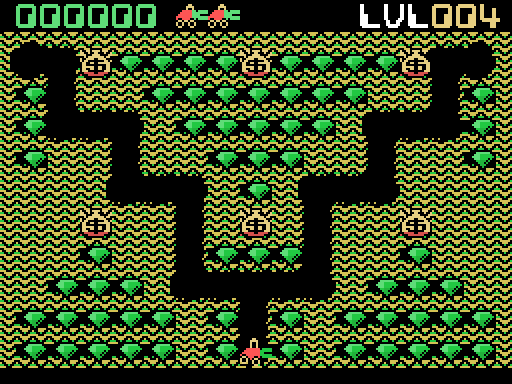
SCREEN 2): Adapted two-color stipple patterns preserve each mine’s distinct color mood within TMS9918A 8×1 color cells.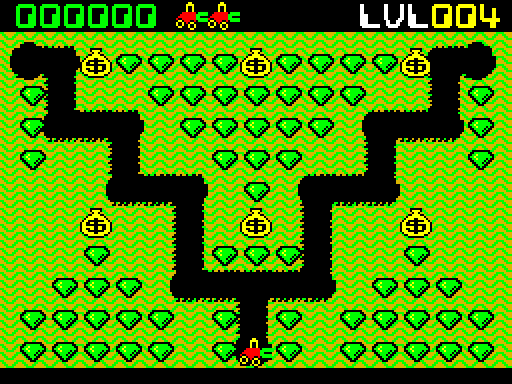
SCREEN 5): Per-pixel bitmap rendering and custom palette colors bring out the bright green-and-gold CGA mine palette.Two-player mines, FlashROM saves, and MSX Game Scores
Both games inside the cartridge include every feature from the 1983 release alongside modern MSX conveniences:
- Alternating Two-Player Mode (
Escat the title screen): Two players take turns at the keyboard or joystick whenever a life is lost, each keeping an independent mine with their own carved shafts, remaining emeralds, resting bags, score, and spare lives—stored in two compact512-byteVRAM slots so even a16 KBMSX1 needs zero extra main RAM. - In-Game
F5Settings Menu: PressingF5(or pausing with Joystick B and pressing Button A) opens a cleanSCREEN 0overlay with independent 10-step Music and Sound Volume bars plus read-only cartridge Flash status, restoring the playfield seamlessly when closed. - Persistent FlashROM High Scores & Online Score Codes: Writable ASCII16-X, MegaFlashROM SCC+ SD, and Carnivore2 cartridges save separate Top 10 tables for MSX1 and MSX2 (holding
Sduring reset skips cartridge boot for easy re-flashing), and every Game Over generates a 16-character verification code for MSX Game Scores.
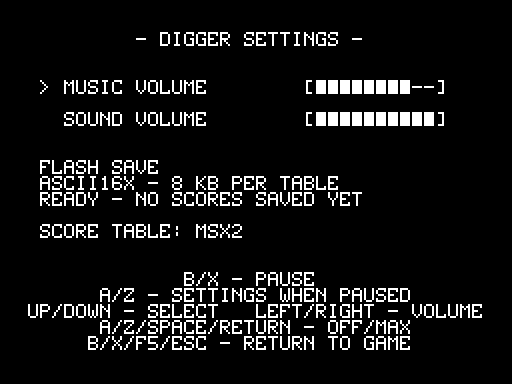
F5 Settings: Ten-step Music and Sound Effects volume bars and live FlashROM save detection, operable from keyboard or joystick.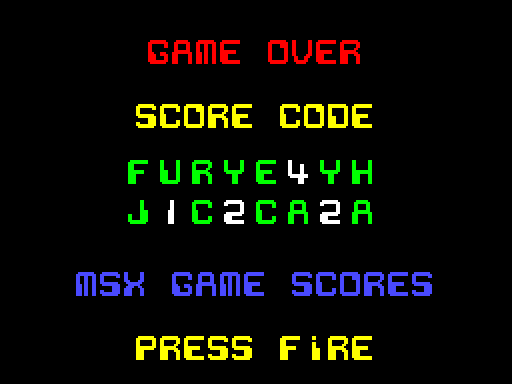
The best surprise of all: made in Canada, minutes from my home
Saving the best twist for last—this project ended with a personal discovery I never could have scripted.
When I was a kid playing Digger on PC back in the 1980s, the line © Windmill Software 1983 at the bottom of the screen felt like a postcard from another world. Later in life, in 2001, I moved to Canada.
More than twenty years after making Canada my home—while putting the finishing touches on this MSX1 & MSX2 edition and checking Windmill Software’s original 1983 booklet and company history—I suddenly realized where Digger had actually been born. Not only was Digger created right here in Canada (founded in Ontario in 1983 by Rob Sleath and Jo-Anne Kempe), the company that made it had been located just a few minutes’ drive from where I live today—right in my own neighbourhood!
All those tunnels across decades and continents, and Digger turned out to be my neighbour all along.

MSX, MSX2, MSX2+, and MSX turbo R support.Original game Copyright © 1983 Windmill Software Inc. MSX & MSX2 dual-game edition presented by Max Iwamoto / Code Busters for MSXdev26 (October 2026).